
Discipleship does not Scale
Are our church forms part of the problem?

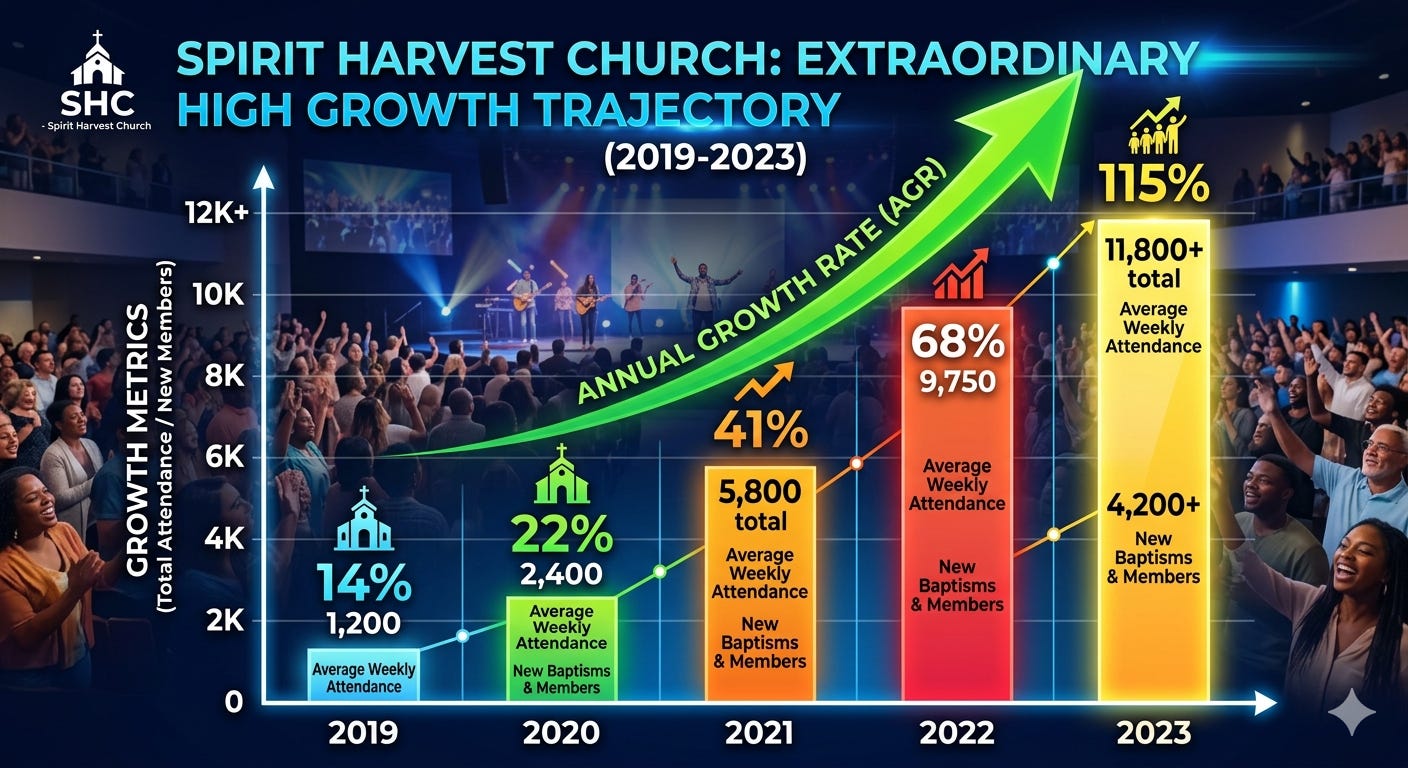
[AI generated image - this is not a real church and if your church is named “Spirit Harvest Church” you might consider a name change (ha!!)]
I am pretty much an agnostic when it comes to church forms. Big churches, small churches, medium sized churches and all fine with me. I love house churches. I have been a part of many different churches. The house church experiences have been, for me, the mountain top experiences. On the other hand, when I had a kid struggling with addiction, the megachurch was there. I praised God for their existence because they could provide resources that little churches simply could not.
A recent report by Outreach Magazine, in the “Outreach 100” report, reveals that big churches are getting bigger (you can fill out a form and get the report here, thanks to Bob Blincoe for alerting me to it).
Life Church (OK) sits at the top of the pile with 85,000 members. If you use the YouVersion Bible app, then you should thank Life Church because they are the ones that created it and have supported it for years. They generously give away a tech platform that helps churches stream and broadcast their services. But 85,000 members? I wonder how many of them have had a lunch with the pastor.
Americans are in love with the mega church model. Consider the following from this Substack article (it is worth reading the whole thing):
The fastest-growing churches are mega churches.
The fastest growing churches are multi-site churches.
Over half of the largest churches are planning to launch more sites within the next year.
Over 5 million Americans get their church at a megachurch or multisite church each Sunday and this is where the church is growing.
Is this a problem?
I think it is. I think our forms are creating weak discipleship. This year, Missio Nexus has been focusing on discipleship as our primary annual topic. We have run articles, done webinars, and we’ll be emphasizing it at our annual conference (tickets just went on sale!). From numerous different people and observing different research studies, I have drawn some broad, admittedly subjective, conclusions.
I recently wrote this for my spring board report:
Discipleship has been a challenging theme for us to tackle this year. Overall, Evangelicalism is struggling with how best to address discipleship. Many of our ministry models are based on growth and scaling. Even if this is not explicitly stated, it is an underlying theme in most churches and many ministries. Discipleship is not something that scales well. It is highly individualized, requires a long time horizon, is much better with the input of others, is very difficult to measure, it is challenging to systematize. Unless we encourage other models of organizational behavior, I don’t think we will see much change.
Growth and scaling are definitely driving the U.S. church toward the multi-site and mega church models. Over a decade ago, Willow Creek Church produced a report showing that they were struggling in the area of discipleship. I don’t think this served as any kind of wake-up call, because since that time, this approach in churches has only exploded.
Is this a US problem?
Mega and multisite churches are not limited to the U.S. In areas where there has been a lot of church growth, particularly in Asia and parts of Africa, we also find large churches.
But scaling will be challenging for the global Great Commission and missionary agencies as well. I see it in the many newsletters and reports I get from certain sectors of the mission industry. They report on the large number of “reproducing churches.” I have walked among some of these large-scale movements outside the borders of the US. Certainly, there is greater persecution in the firmness of faith in many of these places. It is a testament that at least some of these folks are serious followers of Jesus. But I have also heard reports of recidivism on a similarly large scale as the growth numbers indicate.
As we look to future generations of missionaries, how can we expect them to plant churches when they move an incredibly unreached area and are forced by circumstances to plant house churches. I myself had to go through this transition, and my sending church would not be considered a mega church by today’s standards. Almost no U.S. Christians know what life is like in small house churches, yet this is going to be the primary form of church in frontier church planting.
What about the Healthy Church Movement?
I don’t like the polemical use of the phrase “healthy church” or when missions organizations claim they focus on “planting healthy churches.” It is a little bit of an arrogant claim, and many of these churches are every bit as dysfunctional as those found in larger movements. I think, as a goal though, it is something that everybody should be striving for, of course.
Unfortunately, what I see with the “healthy church” folks is also related to church forms. In the US church planting scene over the last quarter century, we have emphasized a model which goes like this: find and vet “the right man,” and you will get a good church on the other end of the process so long as you emphasize these X number of attributes. Rather than focusing on the development of healthy community, we focus on finding “the right man.”
After finding that man, the healthy church advocates focus mostly on teaching and preaching. They operate under the assumption that great preaching will produce a healthy church. For them, discipleship is mostly a teaching process. I am all for good teaching and preaching. Is it producing mature disciples? I do not have any reason to think they are doing better than anybody else in this difficult area of discipleship.
So, smarty pants, what does work when it comes to discipleship?
I don’t know, but I can tell you what my experience has been. As a young Christian, I was in The Navigator’s college ministry. The book “The Lost Art of Discipleship” was our textbook. We spent time memorizing scripture, learning how to study scripture for ourselves, and in significant one-on-one mentoring relationships. We had a small group of around a dozen of us that walked together for three years as new believers, learning about Jesus (sound familiar?). For me personally, this was an incredible discipleship experience.
To return to the initial theme of this post, my college experience does not scale well. The environment of a college campus was well suited for this type of deep discipleship. We had time, lived in community by virtue of the dormitories, and were eager for friendships. When people left the campus, they were busy, lived in private homes, and were not in community-friendly living situations. There was a struggle in making friends. I recall conversations with Navigator staff in which they described how difficult it was to replicate their discipleship process in the community when people left the campus. Life is busy, and when people have full-time jobs and families and are involved in a wide variety of activities, they don’t have the time that we were able to spend on discipleship.
This is only my experience. It does impress on me that our current models are not doing a great job of discipling believers. The forms we choose are contributors to this.
I wish I had better answers to offer.
Ted I agree and I would add one nuance to your argument: the growth of the megachurch movement in the United States is a lagging indicator of our decline. As smaller churches close or weaken, people consolidate into larger churches they believe will add more value to them. What appears as "growth" is actually redistribution within a shrinking ecosystem. To make matters worse, megachurch leaders often interpret the growth of their churches as divine approval.
This helps explain why the megachurch phenomenon (aka the "Walmartization" of American Christianity) feels both impressive and hollow at the same time. Instead of driving renewal, it is absorbing decline. We already have much research on this: the larger the church, the lower the levels of participation in giving, serving, and maturing.
I agree with your core concern. The question is less about which form is best and more about what kind of disciple-making ecology our forms are producing. Where disciple-making becomes programmatic, centralized, and difficult to reproduce, the outcome will remain thin, regardless of size. But where it is embodied, shared, and practiced in community, depth begins to emerge.
Our institutionalized megachurches in America are not designed to produce disciples (Hirsch says they are predicated on non-discipleship). When the medium becomes the message, attractional and consumeristic ecclesiologies shape the kind of disciples we produce. The church in North America has lost 40 million members this century. And just look at our theological drift-- https://thestateoftheology.com, esp statement 7!
We need to do something different. Let's learn from decentralized movements, especially those in the Majority World. This helps us look at the Bible with fresh eyes. I think we will rediscover that NT ecclesiology (theology AND forms) is actually quite robust for discipleship.
It's interesting to me that, in your personal experience, you put your finger on EXACTLY how discipleship scales. If the people IN the small group were ALSO discipling others outside the group, and if THOSE people in turn were discipling OTHERS, then it would scale just fine.
I also think you've put your finger on exactly WHY "movements don't happen here." It's not persecution. It's busyness.
When people ask me why movements don't work in America, I have two answers. (1) people in America don't have a significant felt spiritual need/desperation/hunger. (2) people in America put knowledge-based discovery IN FRONT OF any sort of powerful encounter.
In other places, people have significant and desperate spiritual needs - and they nearly always have a "power encounter" with Jesus BEFORE they begin reading Scripture and attempting to follow him. In America, the question is, "Do you want to learn about Jesus?" In other places, the question seems to be, "Please explain to me the miraculous thing that just happened."