

In the 1970s, churches began, for the first time, giving staff responsibility to the missions arena. Today, an estimated 1,500 to 2,000 mission pastors are working full-time in churches. Larger churches have multiple staff assignments (often around regions of the world, religions, ministry types, etc.). Additionally, partial staff assignments for smaller churches are common. Because the average church size in the US and Canada remains around 80 people, these churches are minority churches. However, many evangelicals attend larger churches. The influence of these 1,500 to 2,000 churches globally is significant, as these are the “activist churches” – the ones most likely to have a global outreach program.
An assumption might be that placing a professional missions staff member into local churches would produce change in mission. This has been true, but probably not in ways that mission agency leaders might have hoped. Since the 1970s, there has been a marked rise in short-term ministry, church-to-church cross cultural partnerships and a rising interest in non-traditional sending models. There has not been a significant rise in missionaries sent, money given, or missionary objectives reached. On the other hand, there has been a significant increase in short-term missions trips. This is because these trips offer local churches one of the best ways to engage their congregants in global mission (one of the items reflected in the chart).
There is a larger discussion here about sodalities and modalities. I’m not going to address that in this article. This gets into what we mean by mission/missions. The chart indicates that churches tend toward broad definitions. If we call a trip to an impoverished Appalachian community “missions” (and many churches do) we probably don’t need a sodality. This is mono-cultural ministry. If we are going to reach Mecca, the need for specialized strategies, people, and spirituality lean more on Paul’s ambitions, and thus a sodality if more necessary.
This chart reflects more about the day-to-day management and leadership paradigms that church mission leaders and mission agency leaders operate under. I do believe that the sodalities-modalities dichotomy is at play here, but I also find that that discussion can sideline us from seeing the more practical things that are happening “on the ground” inside local churches.
To understand these dynamics, the following chart highlights difference that I observe between church mission leaders and mission agency leaders.
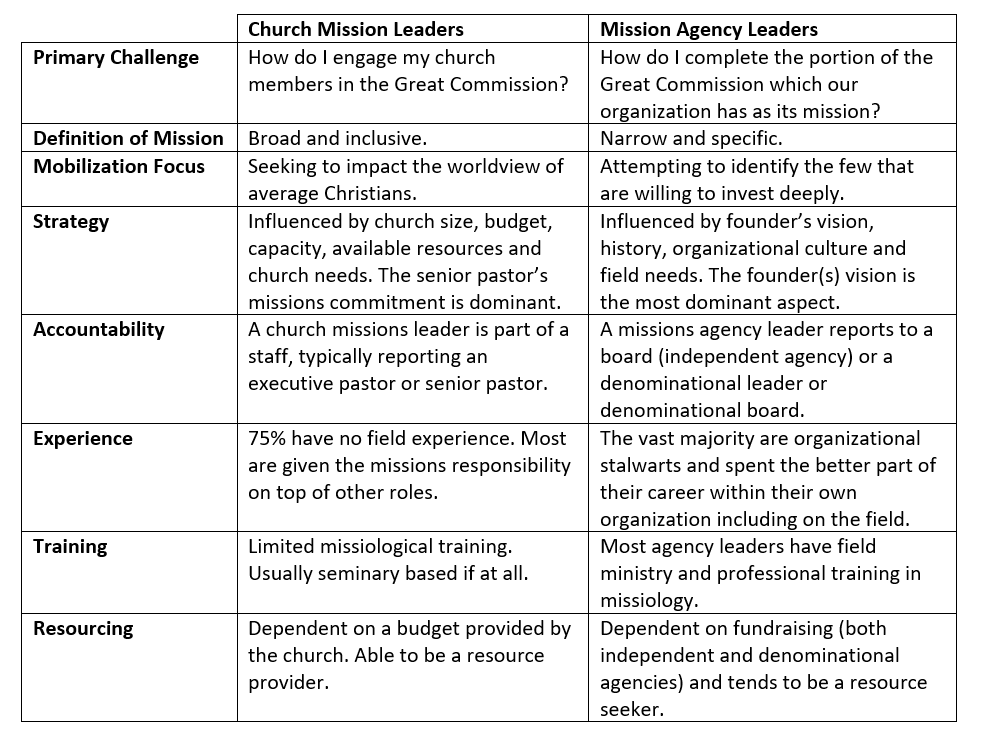
Each of these items presents challenges to both churches and agencies regarding how they might work well together. They also hold clues to what churches and agencies can do to learn better from each other. Empathetic understanding is necessary for church mission leaders and mission agency leaders to work well together. While everybody is seeking to fulfill the Great Commission, how they go about it differs drastically. Through mutual understanding the different viewpoints held by churches and agencies, I am hopeful that we might see more collaboration in the future.
We all know that Paul had a thorn in the flesh that dogged him most of his life. He also had a theological difference with local church leaders surrounding how they approached Gentile missionary work. This difference comes up in almost every single Pauline epistle (Philemon is the exception). One of the reasons that this controversy has been included in the canon is to highlight that the agenda of our local churches are often not the same as the agenda that the missionary has. Paul was seeking greater freedom in forms while the church was trying to enforce forms from Judaic tradition.
Today, we have accusations that missionaries are not following the forms that we use in the West regarding missions outreach. These forms are infused with Reformation-era approaches to doing church. It could be the style of preaching, how we view church membership, or the style and manner in which the missionary acts like a pastor. This is a danger of the “healthy church movement.” I am fully on board with planting healthy churches, but the insistence on Western church forms will lead to the same dynamics we see in the first century church, with the missionary (Paul) opposing the local church leaders (Peter and Barnabas, for example, in Galatians).
It is also worth noting, particularly for missionaries, that in the book of Acts a church council was held to lay down guidelines for missionaries to follow. While those guidelines do offer great freedom, we should be cognizant of the fact that it was a church council that made these decisions. On issues of orthodoxy, the pattern is for church leadership to weigh in and provide guidance.
As we can continue to grow leadership for global missions inside the local church, we need to be cognizant of what we see in the scriptures regarding this relationship between the church and the missionary.
I would be curious about any comments regarding how accurate the chart is and what areas I might have missed.
Here is a comment I received via email from a former missions pastor. I thought it might be good to add it to the comments here:
As I reflect on my time as a missions pastor at a larger church, there is one thing I feel like I did not do well (probably more than 1) and I think it is common in most churches.
There is so much focus on the "here and now" of ministry, that the longer process of developing missionaries is not focused on in most churches. In fact, this is purely an opinion some of the churches that I know that do have better missionary pipelines actually do less on ST, global partnerships etc.
Pastor vision for this matters.
The unique history of the mission's program at the church matters.
End goals for global missions matter.
But what often trumps it in most churches in immediate results, numbers of people engaged and what works on a calendar year cycle. The development of either long-term global partnerships, or creating a long-term missionary pipeline are difficult to sell or keep going because you can go long periods of time without clear tangible reportable results.
The church today is all about results, and results now. This is the negative of business leaders being elders, pastors going through secular leadership and organizational management training as their primary test for "success".
The reality we know is that God's economy is different, time is different. The process of shaping and forming takes time. Something especially in the west we are not willing to have happen, we want results and we want them now.
I agree with Ted Esler. We have two kinds of mission today, one which churches can undertake and complete from within their own administrative leadership. Let's call this Mission One. As Ted wrote, this mission is about sending short term teams and sending money to existing churches overseas. We can say that this kind of mission activity is filling up the excitement quota of many, many churches. Unfortunately, short term trips to existing church ministries overseas and sending money to existing churches is celebrated as though it was the Great Mission of our Lord. Enter Mission Two: small teams who sell their possessions and reside among unreached peoples for years, for the purpose of establishing churches among Muslims, Hindus, or Buddhists in the "regions beyond." I point to the difference between Mission One and Mission Two, realizing that some will object: "Why are you criticizing the church? It is the bride of Christ." Let the bride of Christ "wait upon the Lord with prayer and fasting," and listen for the Holy Spirit to "set apart these few for the work I have for them."