

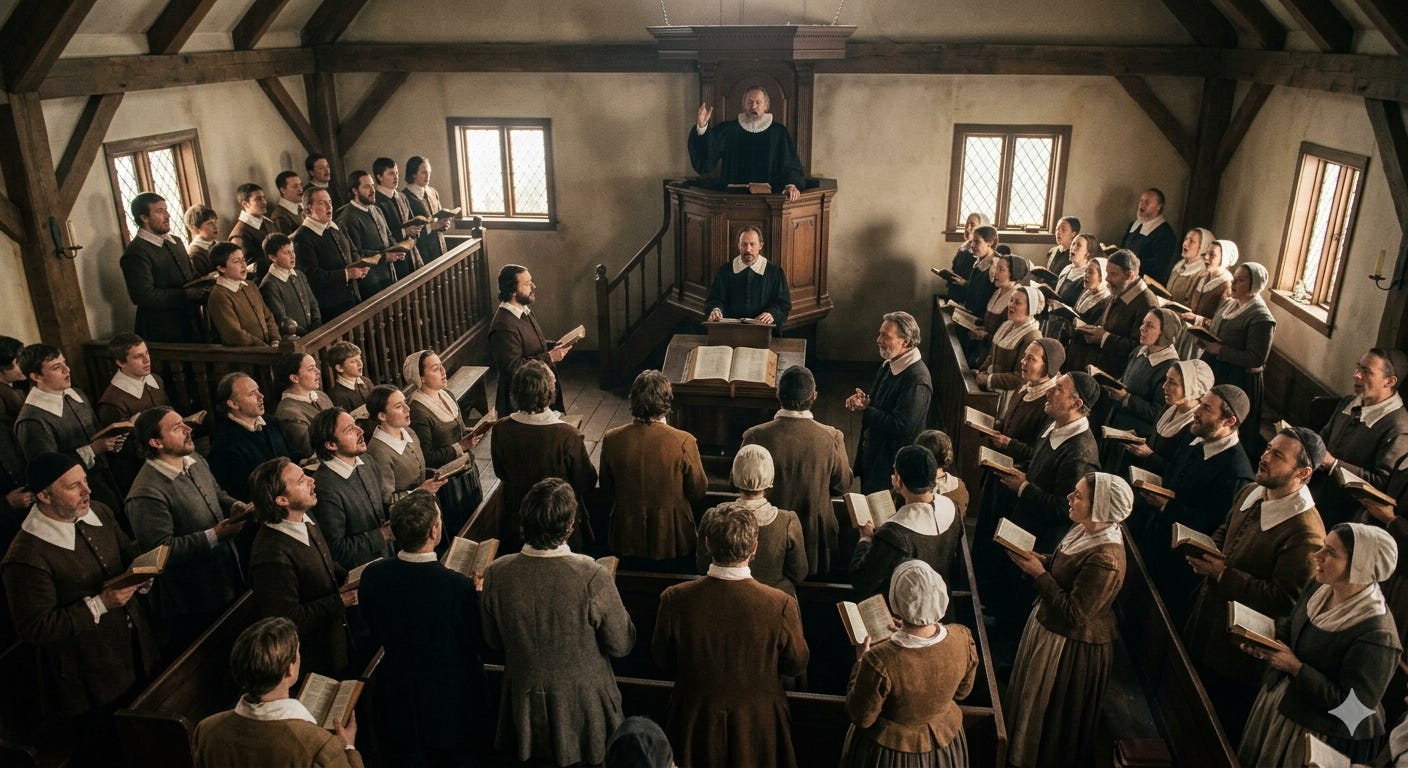
Over the past several years, I have noticed a growing trend in which the Regulative Principle of Worship (RPW) is being invoked as grounds for opposing a wide range of missionary strategies and practices. This application of the RPW to the mission field deserves careful examination, because while the principle itself has a legitimate place in discussions of church worship, its extension into cross-cultural missionary work raises serious concerns - concerns that mission agency leaders and pastors would do well to consider.
Two Principles, One Question
The RPW emerges from one of the Reformation’s most consequential debates: by what standard may the church order its public worship? Two distinct answers developed, and both remain influential today.
The Regulative Principle of Worship holds that only those elements of worship which Scripture positively commands (whether by explicit precept, approved example, or necessary inference) are permissible. Whatever God has not commanded in worship is thereby forbidden. The Westminster Confession of Faith (1646) states it plainly: “the acceptable way of worshipping the true God is instituted by Himself, and so limited by His own revealed will, that He may not be worshipped according to the imaginations and devices of men … or any other way not prescribed in the Holy Scripture” (WCF 21.1).
The Normative Principle of Worship (NPW) takes the converse position: whatever Scripture does not explicitly forbid is permitted, provided it edifies the church and is conducted decently and in order (1 Cor. 14:40). The NPW is defined in the Anglican Thirty-Nine Articles, which grant the church “power to decree Rites or Ceremonies” so long as nothing is ordained “contrary to God’s Word written” (Article XX).
It is important to be clear about what divides these two positions - and what does not. Both affirm that Scripture governs worship. The question is how it governs: does silence grant freedom, or does silence impose a boundary fence? It is beyond the scope of this article to adjudicate fully between these two views, and I would be cautious about dismissing either as untenable. The RPW tends to draw more heavily from Old Testament patterns and boundaries, while the NPW draws more heavily from New Testament principles of liberty and order. Both deserve serious engagement.
A History of Contested Application
Before turning to missions implicationa, it is worth noting that the RPW has been a source of controversy even within its most natural domain - congregational worship. Its application has not always pointed in the same direction.
In the 1690s, the Baptist pastor Benjamin Keach introduced congregational hymn singing to his church, making him one of the pioneers of the practice in English nonconformist worship. He was immediately attacked by others who argued this was a violation of the RPW. Keach’s defense was itself an argument from within the RPW framework. He contended that singing is positively commanded in Scripture, and therefore permissible. The dispute divided his congregation, with both sides appealing to the same principle to reach opposite conclusions.
This history is instructive. Practices we now take entirely for granted (congregational singing among them) were once fiercely contested. The theology of the RPW was wielded both as a weapon of prohibition and as a tool of defense. The principle does not always yield the clear and obvious answers its advocates might suggest.
The RPW Applied to Missionary Strategy
I believe that some of the concern about movement strategies expressed by its detractors have something to do with an RPW attitude. The argument is that the RPW should be applied not just to church worship but to missionary strategy itself, and that doing so rules out a host of contemporary missionary practices.
The debate is most visible in the tension between two dominant models of church planting today. The Proclamational model centers on preaching and teaching as the primary means of evangelism and church formation. The Movement model relies heavily on inductive small-group Bible study discussions, often without a formal preacher, as its primary vehicle for gospel advance.
RPW advocates tend to favor the Proclamational model on the grounds that preaching and teaching are explicitly commanded in the Great Commission passages, that Paul consistently preaches and teaches when entering new cities, and that there is no clear New Testament precedent for evangelistic Bible discussions conducted in a small-group format.
I would suggest that some caution is warranted. Is the absence of a specific evangelistic Bible study format in the New Testament sufficient grounds for forbidding the practice or even discouraging it? One must also ask whether Pauline-style public proclamation is feasible in every context. It is one thing to preach openly in your church pulpit on Sundays. It is quite another to attempt the same approach in Riyadh. The NPW perspective would note that small-group inductive Bible study is not forbidden in Scripture, that it demonstrably bears fruit in many contexts, and that prohibiting it requires a more compelling warrant than its absence from the New Testament record.
It is worth recalling that, before his fall from Mars Hill, Mark Driscoll commissioned a research firm to produce an article arguing that house churches were not normative in the first century - an argument widely and rightly criticized as historically indefensible. The impulse behind that argument, like some applications of the RPW to missionary method, was less about exegetical fidelity and more about protecting a preferred institutional form.
Legitimate Concerns and Their Limits
This is not to say that concerns about methods are not without merit. The excesses visible in some megachurch worship services provide genuine grounds for those who worry about the abandonment of biblical boundaries, both in the US and in Africa. In the missions world, there have been real and serious failures of contextualization. Perhaps the most striking example came roughly twenty years ago, when some missionaries working in Indonesia began reciting the shahada (the Islamic declaration of faith) as a strategy for gaining acceptance within Muslim communities. Whatever the missiological rationale offered, this represented a clear and unacceptable compromise of the gospel message. The RPW instinct to establish firm boundaries is understandable in light of such cases.
But the remedy for excess is not the wholesale imposition of one cultural expression of Christianity onto every missionary context in the world. That remedy creates its own distortion.
The Monocultural Blind Spot
One dynamic that deserves particular attention is the way in which U.S. pastors with little or no cross-cultural experience can unwittingly import their own cultural assumptions into judgments about missionary faithfulness. When a pastor has only ever ministered in a single cultural context, he will naturally tend to favor the forms of ministry known to them, not as one legitimate expression among several, but as the biblical norm. This predisposes such pastors toward RPW-style reasoning, not necessarily out of theological conviction, but out of limited exposure to the genuine diversity of Christian witness across cultures.
A recent thread on X involving leaders at 9Marks illustrates the dynamic (you can read the thread, the article and comments here). The discussion centered on baptism practices, and while the Baptist Press headline was not entirely fair to the nuance of the conversation, what was notable was the degree to which particular church forms were being treated as New Testament principles of church health rather than as historically and culturally situated practices. The response offered by J.D. Greear in the comment thread was more measured and missiologically reflective - the kind of thinking that cross-cultural ministry actually requires. The goal of healthy churches is entirely right. But church health is not produced by strident insistence on church forms that the New Testament itself does not mandate.
Why This Matters for the Mission Field
What I am increasingly convinced of is that the RPW/NPW divide is one of the unacknowledged reasons why substantive conversations about field strategy are so difficult to have. Leaders are often talking past one another without realizing that their disagreements are not simply about tactics or risk tolerance - they are rooted in fundamentally different frameworks for how the Bible governs Christian practice.
In a couple of recent conversations about movements, people have suggested that the core issue between proponents and detractors is ecclesiology. I understand where they’re coming from, but I do think the RPW/NPW issue is at the foundation of the ecclesiological concerns.
The situation resembles a married couple in conflict who lack a shared vocabulary for describing their disagreement. Until they identify the actual nature of their difference, no amount of conversation about the presenting issue will resolve the underlying tension.
Does the RPW/NPW discussion have a place in our missiology? If our missiology is about the church (and properly understood, it should be) then we must necessarily think about how these issues impact our work. I believe there is danger that we would artificially impose our own church practices and justify them inappropriately if we are not careful. There is also danger in abusing freedom.
Mission agency leaders and pastors who care about faithful, fruitful cross-cultural witness would do well to name this divide explicitly, to understand both positions with charitable precision, and to resist the temptation to elevate culturally specific ministry forms to the level of biblical command. Missionaries working in contexts radically different from their own culture need genuine freedom to operate wisely within their local reality. The RPW, rightly understood, was never intended to strip that freedom away.
Great work as usual. This is an article a lot of people need to read.
Excellent article, Ted. I found your observations very helpful, especially the way you framed the tension between different cross-cultural evangelism and church planting methodologies. It is not merely an ecclesiological disagreement, but also reflects how people apply Scripture within a particular context. Our underlying assumptions do need to be challenged regularly. Thank you for this.